
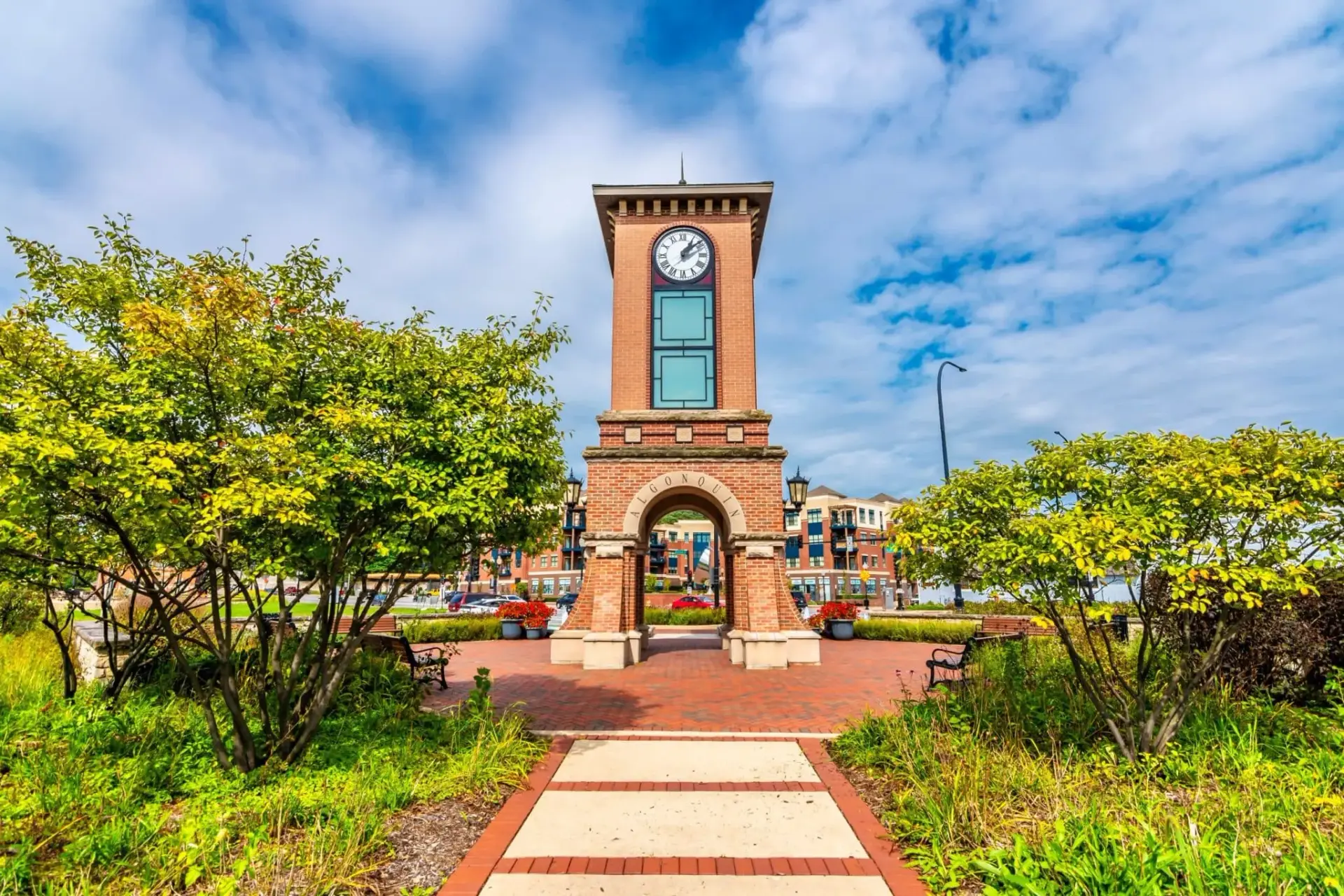
CERTIFIED RESIDENTIAL APPRAISER · ALGONQUIN, IL
Two Counties. Three School Districts. One Market You Need an Appraiser Who Knows All of It.
Algonquin sits at the McHenry-Kane county line, and about 22% of the village's 10,900 homes are in Kane County. That means different assessors, different Boards of Review, and in some cases different property tax bills for nearly identical homes separated by 200 yards. Add three school districts, a Fox River floodplain, and a 1.5% vacancy rate, and the case for a local appraiser writes itself.
$419,000
Median Home Value
+5.55%
Year-Over-Year Appreciation
87.8%
Owner-Occupied Homes
2.18%
Effective Property Tax Rate
1.5%
Housing Vacancy Rate
What Makes the Algonquin Market Different
Algonquin grew by nearly 20,000 people in one decade. The village had 11,663 residents in 1990 and 23,276 by 2000, almost all of it driven by single-family subdivision construction: 594 permits in 2001, 455 in 2002, 384 in 1999. That housing stock from the late 1990s through the mid-2000s now sits 20 to 30 years old, and it represents the core of the Algonquin market. About 61.4% of the housing supply was built between 1970 and 1999. A second construction wave is underway: 178 permits in 2024, concentrated in the Corporate Campus corridor on the west side and newer developments along Randall Road. These two eras are not the same comp pool.
The price distribution reflects a well-established move-up market. The largest single cohort sits between $419,000 and $558,000, at 32.8% of homes. Below that, 35.1% of homes fall in the $279,000 to $419,000 range. Above $558,000, another 15.4% occupy the upper-mid tier, and roughly 5% sit at $698,000 and above, with a small luxury segment along the Fox River that has no comparable elsewhere in the village. The median household income is $131,753. This is not a starter-home market; 48% of homes have four or more bedrooms.
Five-year appreciation here is 59.41%. Homes in Algonquin are worth roughly 60% more than they were in 2020. That moves the market into a range where the gap between a Zestimate and a certified appraisal is not theoretical: it is measured in tens of thousands of dollars on a routine assignment. The tightest inventory in the northwest suburban market (1.5% vacancy rate) means prices have not corrected. Comps from 2022 or earlier are stale in ways that create real liability for anyone relying on them for legal, estate, or financial purposes.
“Willoughby Farms and Copper Oaks are both in Algonquin, both in CUSD 300, and both built in roughly the same era. But one feeds into Jacobs High School and one feeds into Dundee-Crown, and buyers know the difference. So do appraisers who work this market.”
When Algonquin Homeowners Need an Appraisal
The dual-county situation is the defining complexity for Algonquin appraisal work. The McHenry-Kane county line runs through the village, and properties on each side are assessed by different offices, equalized by different factors, and subject to different Board of Review processes. McHenry County's effective rate is 2.18%; Kane County's is 2.05%. On a $419,000 home, that is roughly $545 per year in difference for identical properties separated only by which side of the line they sit on. An appraiser who works only one county cannot pull adequate comps for properties near that line, and cannot correctly advise on the appeal process for the other county's Board. We cover both.
With a median household income of $131,753, an 87.8% homeownership rate, and 64.3% of households in married-couple arrangements, Algonquin generates steady estate and divorce appraisal demand. The village skews established: median age 42, average household size 3.13, 34.3% of households with children under 18. These are long-term homeowners with significant equity, and when estates transfer or marriages dissolve, the documentation requirements apply. Illinois courts require a certified property valuation for equitable distribution. An online estimate on a $450,000 Willoughby Farms colonial with Fox River flood zone proximity is not a document that will satisfy court evidentiary requirements.
Neighborhoods We Appraise in Algonquin
Old Town sits on the Fox River bluffs along Route 31 and is the most distinct appraisal micro-market in the village. Properties here include homes from the 1940s through the 1970s on smaller, irregular lots with river proximity and walkable access to the downtown core: restaurants, boutiques, Hill Climb Park, and the Village Hall (built 1907). Old Town's comp set is different from anything in the 1990s subdivisions, and Fox River flood zone designations are relevant for properties along the riverbank. The premium for river view or access is real and documented. The discount for FEMA Zone AE placement is equally real.
The 1990s through 2000s boom subdivisions east of the Fox River and along the Randall Road corridor are where the majority of Algonquin's housing stock sits. Willoughby Farms on the west side of Randall feeds into Jacobs High School through Westfield Community School, the top-appreciating school feeder cluster in the village. Copper Oaks ranks first in five-year appreciation among all Algonquin neighborhoods. Gaslight North and Eagle Ridge rank second. Dawson Mill third. These neighborhoods are close in construction era and style, but the school district boundary between Jacobs and Dundee-Crown creates measurable price differentiation that requires careful handling in the comp selection process.
The far western edge of Algonquin, near Square Barn Road and the Huntley Road corridor, falls into Consolidated School District 158 and feeds into Huntley High School rather than the CUSD 300 campuses. This is the newest construction area in the village: 2020s-era homes, the Corporate Campus development, and expanding residential on the outer ring. Properties here need comps drawn from the same school district and construction vintage, not from the CUSD 300 neighborhoods two miles east. The far eastern portion of the village in Kane County, primarily the Algonquin Lakes subdivision, uses the same CUSD 300 school feeders but belongs to the Kane County assessor and requires Kane County Board of Review appeals.
Served by Our McHenry Office
Algonquin is served by VanEtten Appraisal's McHenry office. We cover all of the surrounding communities and schedule inspections throughout the county.
Learn more about our McHenry OfficeHome Appraisal FAQs for Algonquin
Can't find your answer? Call us at (815) 201-1866.
Get Your Algonquin Appraisal Started
Call us directly or fill out the easy form below. You'll hear back from us quickly.
- Fast communication, real answers. No waiting around.
- No obligation, just accurate information
- Serving all of Northern Illinois from 4 locations
- Reports accepted by all major lenders and courts